MOTION OF THE HAND:
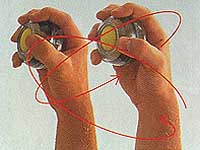 Dynaflex is held by a prehensile power grip. The object is clamped by the partly flexed fingers from co-contraction of the profundus and superficialis flexor muscles, and extensor digitorum. Also stabilizing demands are placed on both the volar and dorsal interossci and on the lumbricales. It is held in the palm by counter pressure applied with the thumb in opposition. This is accomplished by contraction of the abductor pollicis, and flexor pollicis longus and brevis. In addition, static contraction of the opponens pollicis and opponens digiti minimi occurs. During the work phase of the activity, these muscles are exercised in an isometric manner. The length of the muscles is maintained, while the tension within the muscle is increased and/or decreased as the demands of the gyroscopic force change. Grip strength studies show that the limiting factor appears to be the ability of the thumb to oppose the force of the fingers. Dynaflex is able to successfully exercise these muscles, and their related synergistic groups.
MOTION OF THE FOREARM:
Rotation of the forearm also assists in maintaining the speed of the Dynaflex. The pronator and supinator groups act as antagonist, stabilizer and antagonist in a similar fashion as the muscles of the wrist. The biceps brachii assists with supination, and the brachioradialis assists in pronation to midpoint when the elbow is flexed to 90 degrees. The action of the forearm is performed in mid-position to pronation, and the radius is rotated across the ulna, or in mid-position to supination where the bones lie parallel to each other.
MOTION OF THE WRIST:
To maintain or increase the speed or rotation of Dynaflex, the motions in the wrist rotate in the opposite direction. Each of the muscles of the wrist functions as an antagonist, a stabilizer, and an antagonist as the load shifts. The degree of motion of the wrist is inversely proportional to the speed of thrust of Dynaflex. At high speeds, the wrist is exercised within a range parameter that allows the greatest strength of prehensile position for the hand; the wrist is in mid-position and rotating within 10 - 15 degrees of flexion, and extension.
MOTIONS OF THE ARM, SHOULDER AND SHOULDER GIRDLE:
The muscular action of the arm, shoulder and shoulder girdle is primarily of stabilization for the activity of the forearm, wrist and hand. The specific demands on the muscle groups in these joints are variable according to the position of the extremity. For example, Dynaflex is held in the hand pronated, the elbow is extended, the shoulder is abducted and internally rotated, and the shoulder girdle is upwardly rotated and abducted. All musculature of these joints are co-contracting for stabilization. However, greater strength demands are placed on the elbow extensors, the shoulder abductors and external rotators, and the shoulder girdle abductors and the rotator cuff muscle groups. The demands are extremely variable, and can be changed to obtain specific results by positioning the extremity.
Also see: The Dynaflex Pro Plus and Dynaflex Pro

 Contents Funded and Copyright © 1994-2008 by